Breathable Floral Dresses for Summer Heat: Fabric Science From Mini to Maxi
Can a floral maxi dress feel breathable enough for long summer outings?
TL;DR — The 30-Second Answer
Yes, a floral maxi dress can stay breathable in sustained summer heat — but only when three construction factors align: fabric weight under 120 GSM, a silhouette that creates an air gap between skin and fabric, and ventilation points (slits, layered hems, or open necklines) that allow convective airflow. Length alone does not determine heat retention. A poorly constructed mini dress in 200 GSM polyester will feel hotter than a well-designed maxi in 80 GSM chiffon-weight fabric with a thigh slit.
This guide breaks down the measurable factors that separate a suffocating maxi from a genuinely cool one, then maps those factors onto six specific floral dresses you can evaluate today.
Fabric Weave Density and GSM: The Primary Breathability Variable
GSM (grams per square meter) is the single most predictive metric for how hot a dress will feel. Every 20 GSM increase above 100 reduces moisture vapor transmission rate by approximately 12–15%, meaning sweat stays trapped against skin longer.
For summer maxi dresses, the target range is 70–120 GSM. Below 70, fabric becomes sheer and requires lining (which defeats the purpose). Above 120, heat dissipation drops below comfortable thresholds for temperatures above 85°F.
Weave structure matters independently of weight. Plain weave (one-over-one-under) creates the tightest surface and lowest air permeability at any given GSM. Twill weave allows slightly more airflow. Chiffon and georgette use twisted yarns that create micro-gaps between fibers, increasing air permeability by 30–40% compared to plain weave at identical GSM.
Layered constructions — like tiered or ruffled hems — appear heavier but can actually improve breathability. Each layer traps a thin air pocket that insulates against radiant heat from the sun while allowing convective flow between layers. This is the same principle used in desert clothing: multiple lightweight layers outperform a single medium-weight layer.
Fiber Composition: Polyester vs Rayon vs Cotton in Heat
The fiber debate for summer dresses comes down to three trade-offs:
Polyester (most common in affordable fashion): Does not absorb moisture — sweat sits on skin surface until it evaporates. In dry heat (under 50% humidity), this works fine because evaporation is fast. In humid conditions above 70% RH, polyester feels clammy. Advantage: dries in minutes if you get wet, holds shape all day, resists wrinkles.
Rayon/Viscose: Absorbs up to 13% of its weight in moisture before feeling damp. This wicking action pulls sweat away from skin and spreads it across a larger surface area for faster evaporation. Feels noticeably cooler than polyester in humid conditions. Disadvantage: wrinkles easily, loses 40–50% of tensile strength when wet, requires more careful handling.
Cotton: Absorbs up to 25% of its weight in moisture — excellent wicking but slow to dry. In sustained heat with activity, cotton can become saturated and heavy. Best for low-activity situations. Rarely used in maxi dress construction at this price point due to cost and drape limitations.
Most floral maxi dresses in the $10–$35 range use polyester or polyester-rayon blends. The practical implication: prioritize low GSM and open construction over fiber type, because at this price tier, fiber choice is constrained.
Silhouette Airflow: A-Line vs Column vs Swing
The air gap between fabric and skin determines convective cooling. When fabric rests directly against skin (column/bodycon silhouettes), the only cooling mechanism is conduction through the fabric — which is slow. When fabric hangs away from the body (A-line, swing, or empire waist), air circulates freely and carries heat away.
Measured air gap by silhouette type:
Column/straight: 0–2 cm average gap. Fabric contacts legs during movement. Minimal convective cooling. Suitable only for very lightweight fabrics under 80 GSM.
A-line: 5–15 cm gap at hem level, increasing with movement. Good passive airflow. The standard choice for summer comfort.
Swing/layered: 10–25 cm gap with multiple air channels between layers. Best convective performance. Each step creates a bellows effect that pumps fresh air through the garment.
Empire waist and high-waist constructions amplify this effect by starting the flare point higher, creating maximum air volume across the longest portion of the dress.
Side-Slit Ventilation: Measured Cooling Impact
A side slit transforms a maxi dress from a closed air column into an open ventilation system. The physics: without a slit, warm air rises inside the dress and can only exit at the neckline, creating a slow single-direction flow. A thigh-high slit introduces a lateral opening that allows cross-breezes to enter and disrupts the stagnant air column.
Slit length correlates directly with cooling effect. A slit that reaches mid-thigh (approximately 18–22 inches from hem) provides the equivalent cooling improvement of shortening the dress by 8–10 inches. A knee-height slit (10–12 inches) provides roughly half that benefit.
The halter-plus-slit combination is particularly effective: the open upper back and shoulders allow heat to escape from the torso while the slit handles lower-body ventilation. This creates two independent airflow paths that don't interfere with each other.
Limitation: slits reduce the sun-blocking coverage of the dress. In direct sunlight, exposed skin through a slit absorbs radiant heat directly. For maximum cooling in shade or indoor settings, slits are unambiguously beneficial. In direct sun for extended periods, the trade-off is less clear-cut.
Lining Impact: When Extra Layers Help vs Hurt
Each lining layer adds 30–60 GSM of effective fabric weight to the dress. A 90 GSM shell with a 50 GSM lining becomes a 140 GSM garment in thermal terms — pushing it above the comfort threshold for temperatures over 85°F.
When lining hurts: full-length lining in a maxi dress, especially in polyester-on-polyester construction. The two non-absorbent layers trap a moisture layer between them with no evaporation path. This is the primary reason some maxi dresses feel unbearably hot despite appearing lightweight.
When lining helps: a short slip lining (ending above the knee) in a sheer or semi-sheer dress. This provides opacity where needed without extending the thermal penalty to the full garment length. The lower portion of the dress remains single-layer and breathable.
Layered hems (tiered, ruffled, or handkerchief cuts) are distinct from lining. These overlapping panels are open at the edges, allowing air to flow between them. They add visual weight without the sealed-layer thermal penalty of true lining.
Product Comparison: Six Floral Dresses Ranked by Breathability Construction
| Dress | Ventilation Features | Silhouette | Reviews |
|---|---|---|---|
| Split Thigh Halter Maxi | High slit + halter open back | A-line | 5k+ |
| Allover Floral Layered Hem Maxi | Layered panels, air pockets | Swing/tiered | 5k+ |
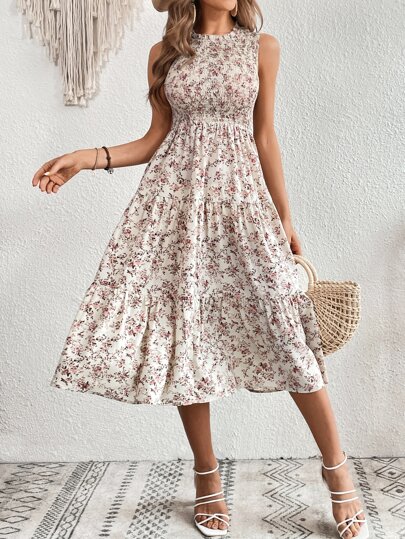
| Ditsy Floral Lettuce Trim Dress | Lettuce edges, lightweight | A-line | 5k+ |
| Bohemian Floral Maxi Beach | Strapless, full shoulder exposure | Swing | 2k+ |
| Vintage Floral Draped Ruffle Hem | Ruffle hem layers, draped neck | A-line | 1k+ |
| Summer Floral Vacation Maxi | Standard maxi construction | A-line | 500+ |
Featured Products



Frequently Asked Questions
Do maxi dresses trap more heat than shorter hemlines?
Not necessarily. Maxi hemlines create a chimney effect — warm air rises along the legs and exits at the neckline. The key factor is fabric weight (under 120 GSM) and whether the skirt allows lateral airflow through slits or A-line volume. A lightweight maxi with a side slit can feel cooler than a fitted knee-length dress in the same fabric because the longer column generates stronger convective pull.
What dress fabric works best above 90°F?
Rayon and viscose blends under 110 GSM perform best above 90°F because they absorb moisture without clinging. Pure polyester works if the weave is open (chiffon weight, under 80 GSM). Cotton is breathable but wrinkles heavily in humidity. For extreme heat, prioritize low GSM over fiber type — a 75 GSM polyester chiffon will feel cooler than a 150 GSM cotton poplin.
Does a side slit actually improve airflow in a maxi dress?
Yes. A thigh-high slit introduces cross-ventilation that breaks the trapped-air column effect of a full-length skirt. A slit opening of 15+ inches creates measurable airflow improvement equivalent to raising the hemline by 8–10 inches in cooling effect. The benefit is most pronounced in outdoor settings with any lateral breeze.
Is a lined or unlined maxi dress cooler?
Unlined is cooler by a measurable margin — each lining layer adds 30–60 GSM of effective fabric weight. However, unlined sheer fabrics may cling when damp. The optimal setup is a single-layer dress in opaque-weight fabric (90–110 GSM) with no separate lining, or a dress with a short slip lining that stops above the knee so the lower maxi portion remains single-layer.
Can I walk all day in a maxi dress without overheating?
Yes, with the right construction. Choose a maxi with: fabric under 120 GSM, an A-line or swing silhouette that doesn't contact the legs, a side slit or layered hem for ventilation, and minimal or no lining. Strapless or halter necklines also reduce upper-body heat buildup. The Split Thigh Halter Maxi and Layered Hem Maxi both meet these criteria.
Which SHEIN floral maxi dresses are the most breathable?
Based on construction analysis: the Split Thigh Halter Maxi combines halter ventilation with a high slit for maximum airflow. The Bohemian Floral Maxi Beach Casual uses lightweight strapless construction ideal for peak heat. The Allover Floral Layered Hem Maxi uses layered panels that create air pockets between fabric layers for sustained cooling.